WOMEN’S INDEX SHOWS PROGRESS IN GENDER EQUALITY HAS BEEN HELD BACK BY PAY GAP AND COVID DISRUPTIONS.
Key Results: • The Financy Women’s Index (FWX) improved 0.5 points to 72.9 points in the June quarter, reflecting a rebound in economic gender equality. • Improved gender diversity on ASX 200 board positions and a closing of the gender gap in the underemployment rate supported the FWX score. • But a worsening gender pay gap coupled with faster male employment growth than female, held back progress. • Year on year, the FWX is yet to recover from the disruptions of the pandemic and is down 0.3 points compared to June 2021 (73.3 points.) • Years to equality in ASX 200 board leadership improved to 6.2 years, from 6.4, the timeframe to equality in the gender pay gap worsened to 23.4 years from 22.7 and the total timeframe to gender equality remained unchanged at 59 years, based on the worst area – unpaid work.
Regression in the gender pay gap and a stronger pickup in male employment growth over female in the June quarter has stifled a rebound in Australia’s progress to gender equality, the latest Financy Women’s Index (FWX) shows. The FWX is a quarterly measurement of the economic progress of women and timeframes to gender equality in Australia. The FWX provides a snapshot on gender equality across seven critical areas: education, employment, underemployment, wages, unpaid work, ASX 200 board gender diversity and superannuation.
Overall, the Financy Women’s Index (FWX) rose by 0.5 points to 72.9 points in the June quarter from 72.5 points in March helped by a small increase in the number of women joining ASX 200 boards and a narrowing of the gap between males and females in the underemployment rate. But the FWX is yet to recover to where it was at the end of 2021 (73.2 points in December 2021) and in annual terms, the FWX is 0.3 points lower than where it was in June 2021 (73.3 points).
“It’s great that we are seeing an overall pick up in women’s financial progress and gender equality outcomes, but we need momentum, and not regression in the gender gaps in employment and wages, if we are to claw our way back from the disruptions of the pandemic,” said Bianca Hartge-Hazelman founder of the Financy Women’s Index.
The Coronavirus pandemic is largely to blame for disrupting a decade of positive momentum in gender equality progress in Australia, particularly when it comes to employment and wages. Since March 2012, the FWX headline score had been increasing with each passing year and progress started to hit its stride from December 2017, when the FWX recorded quarter-on-quarter sustained growth helped by improved gender gaps in employment, wages, leadership, unpaid work and superannuation. But in December 2020 the impact of the pandemic became most apparent with the Women’s Index suffering its first quarterly drop in some time and most significant fall of 3 points on record. The FWX fell to 72 points in December 2020, from 75 points in September 2020.
Holding back economic gender equality in the June quarter has been a worsening gender pay gap which widened to 14.1% in May, based on the latest Average Weekly Wages data released by the Australian Bureau of Statistics on Thursday. The gender divide also widened in employment with the number of monthly hours worked by men up by 2.8% in June compared to 1.3% for women. “The Financy Women’s Index has shown welcome progress in the June quarter but is still down from its 2020 high and there remains a long way to go before women achieve economic equality with men,” said Dr Shane Oliver, Chief Economist, AMP Capital. “The pandemic showed a path forward in enabling more flexible working, but it also had a darker side in seeing many women take on more of the tasks around the family and home. The key is to build on the positives and keep the momentum to improvement going.” In terms of timeframes to economic gender equality, women are now closer to achieving gender equality in ASX 200 board leadership than for any other
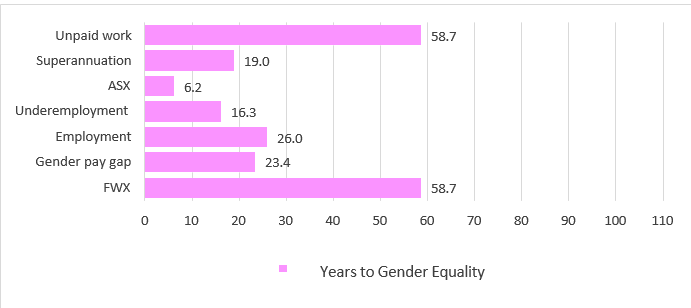
FWX indicator. Chart 1: Timeframes to Economic Gender Equality
The FWX ASX Leadership sub-index improved to 6.2 years from 6.4 years based on the rate of annual growth over the past decade. “But the pace of progress towards gender equality in leadership continues to slow and because of this, it is questionable if we will even achieve equality before 2030 in this area,” said Ms Hartge-Hazelman.
A widening Gender Pay Gap in May resulted in the timeframe to equality in this area increasing to 23.4 years from 22.7 last quarter. The worst performing area of the FWX remains Unpaid Work, which stands at 59 years before equality is achieved, based on the most recent data update in the March quarter. This timeframe is about double that seen in Employment, where the years to equality fell to 26 years in June, from 26.3 in the previous quarter. Superannuation has an unchanged timeframe to equality at 19 years, which is an improvement on the revised 31 years as reported in December 2021. The time to equality in Underemployment worsened to 16.3 years from 15 years in the March quarter and has been affected by recent volatility during the past two years relating to the pandemic.
“We’re decades away from equality and that makes me frustrated and fired up! For others feeling this same way, let these statistics be a catalyst behind driving action,” said Dr. Lili Sussman Chief Strategy Officer Wisr. “Employers should be re-evaluating how equal their processes really are. From recruitment onwards, Wisr’s processes encourage systemic change, eradicating the traditional aspects of the recruitment, promotional and remuneration processes that have kept marginalised people from excelling.”
Some of the key trends making a difference are the number of female founders, the war for talent and the acceptance of flexible working.
The number of female founders has been steadily increasing for the last decade. Today 34% or 668,670 women are business owners which is a 46% increase in the number of women business operators over the past two decades. The exciting impact of this on the gender economy is that women are supporting other women. According to Alanna Bastin-Bryne, co-founder of Femeconomy, “A business with a female founder and female executive employs 6x more women. They are part of the solution to improve women’s economic security and workforce participation.”
The war for talent is real with a shortage of skilled staff everywhere. This has made it more important than ever before for employers to stand out. Small business owners are nimble and quick to respond to opportunities and often very flexible in relation to hours worked, remote working, and health care issues all of which create an ideal environment for more women employees.
An example of how small businesses can be different is demonstrated by Sabio. They are an award-winning PR firm that offers benefits like a 9-day fortnight, remote and flexible working with the added bonus of a day off to celebrate your Birthday. Plus, they really get the health issues, providing their team with the obvious parental leave benefits and then they go a step further to include miscarriage leave and support. So, it’s no surprise that they have attracted a high number of female employees.
The value-driven businesses focused on “making a difference” are another way to attract a team who are passionate and willing to go above and beyond. Thank-You and Who Gives a Crap are both great businesses that people would be proud to work for. Both brands work to provide water, sanitation and health for those in poverty which is one of the key criteria for helping countries towards Gender Equity. And we know gender equity is good for business. When you have a team that loves coming to work, they are motivated and do a great job!
Some of the facts…
Small business is the engine of Australia’s economy with more than two million trading businesses, around 96% are small enterprises with up to 19 employees. That’s about 5 million people of which 85% are men and 65% women. The 20% gap is making a big difference to the economic security of women and gender equity over their lifetime.
Obviously, women taking on the caring role of the family & elderly parents is a key factor in driving these numbers.
There are two factors that will make a difference. One is the access to employers who can work flexibly with the woman’s limitations and the other is access to affordable childcare.
The last two years of COVID have moved the dial on the acceptance of flexible and remote working. This has enabled a number of women who previously had not been able to work to enter the workforce.
And in answer to affordable childcare recently the Victorian Government has committed $9 billion to expand kindergarten programs across the state. This means that: From 2023, free kindergarten programs will be available for all Victorian three‑ and four‑year‑old children at participating services – a saving of up to $2,500 per child, every year and creating 15 hours of free time for the primary carers. It is estimated that this will impact as many as 25,000 women
So, what are some of the stories we haven’t heard?
It’s your chance to stand out as an employer of choice and be recognised through the gender Equity Awards.
FOCUS on Excellence
SHARE & CELEBRATE best practice
ACKNOWLEDGE great behaviour
ENCOURAGE improvement
EXPEDITE 50/50 before 2130
These Gender Equity Awards will work to inspire a groundswell of activity by acknowledging great ORGANISATIONS and INDIVIDUAL advocates. The sharing of their stories and best practices will give others a roadmap and the incentive to succeed.
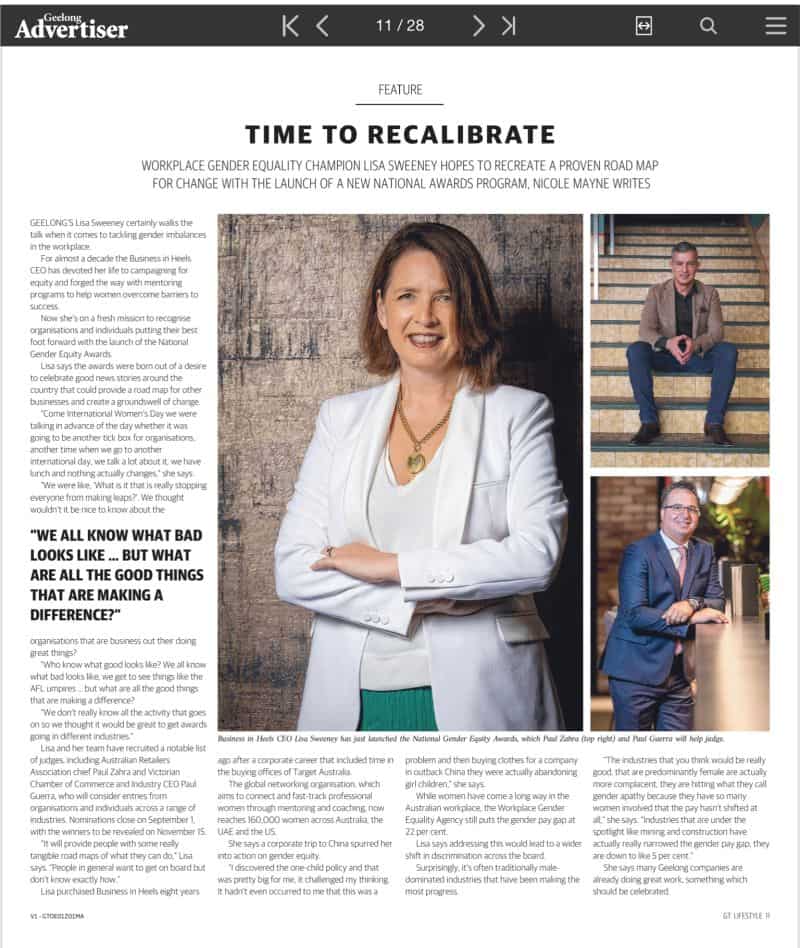
Ms Sweeney, CEO of Business in Heels, said she hoped the awards would bring many positive stories to light and create a groundswell of good news stories about gender equity. “Every little bit counts and maybe this will be the tipping point in driving change. I would like to see some major change in my lifetime.”
Entries close on August 31 and finalists will be announced on October 1. The awards will be held on November 16th at Crown Casino in Melbourne. To enter it is simple and takes less than 10 minutes. https://aij.dzr.mybluehost.me/website_40de3b07/
According to WGEA 2021 report, “Increasing the share of women on boards leads to better outcomes for gender equality …across a suite of metrics”.* In fact they found that a board of 50-50 has led to a 6.3% reduction in the gender pay gap for full-time managers.
Why does this make a difference?
According to Paul Zahra Australian Retailers Association CEO, and judge for the Gender Equity Awards,” If you take a look at retail, women contribute around 75% of consumer spending and make up 57% of our workforce, yet only occupy 27% of board positions at Australian retailers. For a business to truly achieve gender equality, the leadership needs to come from the top and companies need to ask themselves if their executives are a reflection of their broader workforce and customers, and if not – why not?” He sees the results across the entire retail industry and he agrees that “Gender equality comes down to leadership, and the best action corporate Australia can take is setting and maintaining a 50-50 representation of women on company boards.”
And if we take Australia as a whole, whilst some businesses are taking action, there is still a long way to go. Many of the companies claim the problem is the lack of talented women who can contribute to boards.
We asked another judge, Jo Plummer, experienced board Chair, whether she felt this was an adequate excuse.
“Like with most change, it requires the courage to think and act differently. It’s often the embedded systems that hold us back when it comes to creative thinking and like with little red cars, once you see one……they’re everywhere! I was speaking with an experienced female recruiter regarding ASX directorships just two months ago who told me their clients would only likely consider candidates with C-suite experience*#@! We know that is a very small pond to fish in and is unlikely to address gender equity across ASX directorships. Great female talent exists in all sorts of crevices which we must be prepared to explore.” A very small pond indeed with only 18 CEO in ASX listed companies as of 2021. She went on to suggest that skilled CEOs were to be found in our entrepreneur community running medium businesses.
From the recruitment perspective yes, good talent is hard to find, especially if you are looking for a tick box solution. There are many capable women out there that could do a brilliant job as board directors, however, all too often firms are insisting they have ASX, C-suite experience. It is the next bias to look for board directors who reflect the existing team, rather than reflect their consumers & stakeholders. Sharon Crain, Managing Director, Open Door Recruitment and Development has this challenge every day as she focuses on female recruitment. Her advice is to businesses looking to find more female board members need to “make a conscious decision to change and be willing to compromise to achieve that change”.
Encouraging open-minded thinking is one-way boards can open themselves up to more diversity which has been proven to lead to better profits and business success.
If you know of other activities or companies that are driving gender equality we encourage you to invite them to enter Recalibrate: Gender Equity Awards to determine what are the best practices for businesses of all sizes. We want to know who the individuals are making a difference, and to celebrate their achievements. The goal is to speed up gender equity by raising awareness of great behaviour and sharing best practices.
The Awards close on 30th August. https://aij.dzr.mybluehost.me/website_40de3b07