
The Equity Evolution: Powerful Ideas from Award-Winning Workplaces

The Equity Evolution: Powerful Ideas from Award-Winning Workplaces

Each year, the Gender Equity Awards shine a powerful spotlight on the organisations and individuals who are actively dismantling systemic barriers and rewriting the rules for workplace inclusion. These awards aren’t just about recognition, they’re about uncovering, sharing, and scaling the best ideas that move the needle on equity for everyone.

From policy overhauls and bold leadership to culturally inclusive practices and progressive benefits, the Awards celebrate practical, real-world solutions that others can adopt. Because when one workplace leads with intention, many others follow and that’s how real change happens.

In this feature, we’re highlighting some of the most inspiring initiatives from recent nominees and winners—proof that small changes, sustained with purpose, can lead to transformational outcomes.

Best Practices for Gender Equity in the Workplace

1. Capgemini – Inclusive Parental Leave

Capgemini has overhauled its parental leave policies, moving from separate maternity, paternity, adoption, surrogacy, and shared leave offerings to two inclusive parental leave programs covering all situations. Employees can now access up to 24 weeks of fully paid leave, along with flexible compassionate and bereavement leave options. Source.

2. Coulter Legal – Choose Your Public Holidays

Coulter Legal champions cultural inclusion by allowing employees to choose which public holidays they observe, based on personal, cultural, or religious significance (Source). This gives staff real autonomy over their holiday schedules and supports diversity without compromising business needs.

3. TelstraSuper – Full Super Contributions Return from Parental Leave

TelstraSuper offers full-time Super Guarantee contributions for two years to employees who return part-time after parental leave. This policy ensures returning parents—especially women—secure their long-term retirement savings despite hours reduction ( Source)

4. Dentons – Expanded Family Leave

Dentons now supports a wide range of family structures, including aunties, grandparents, adopters, IVF parents, and traditional parents. While global top-ups and leave duration are evolving, the firm has extended benefits up to 26 weeks with a salary top-up, demonstrating comprehensive family support.

5. Zero Gender Pay Gap Alignment

Dentons has officially become the first large law firm in Australia to report a 0 % median gender pay gap for 2025, according to its Workplace Gender Equality Agency (WGEA) report (Source)

 Highlights include:

  • Pay gap progression: 15 % (2022) → 7.1 % (2023) → 4.1 % (2024) → 0 % (2025)
  • Driven by their “Gender 360 – Equity from Every Angle” strategy:
    • Annual remuneration audits
    • Inclusive recruitment and promotion pathways

6. The Ascott – Menstrual & Menopause Leave

The Ascott Australia introduced six days of paid menstrual and menopause leave per year, along with education programs on reproductive health. This policy, launched in 2023, is part of their drive toward gender equality and has earned industry awards. (Source)

7. Coulter Legal — Parental Leave Extended

Coulter Legal’s comprehensive parental leave program (introduced March 2022) offers 18 weeks of paid leave, available regardless of gender or caregiving role, including:

  • Paid leave for fertility treatment
  • Paid leave for pregnancy loss
  • Super contributions on unpaid parental leave for up to 12 months
  • Paid postnatal appointment leave in the first year after return

Your Turn to Inspire

The ideas shared here are more than just best practices—they’re proof points that inclusive, equitable workplaces are not only possible, but powerful. Whether it’s offering flexible public holidays, introducing menopause leave, or closing the gender pay gap, these initiatives show what’s achievable when leadership is aligned with values.

If your organisation is driving change—big or small—we encourage you to step into the spotlight. Share your story, celebrate your team, and inspire others by entering the Gender Equity Awards.

Because the future of work is shaped by those who dare to lead it.

👉 Entries are now open—nominate your organisation or an equity champion today. https://genderequityawards.com/

Gender Equality in Australia: A Snapshot of Progress and What Still Holds Us Back

Gender Equality in Australia: A Snapshot of Progress and What Still Holds Us Back

Gender Equality in Australia: A Snapshot of Progress and What Still Holds Us Back

Australia is making headway on gender equity, but the full picture is both encouraging and sobering.

📈 The Good News: Momentum Is Building

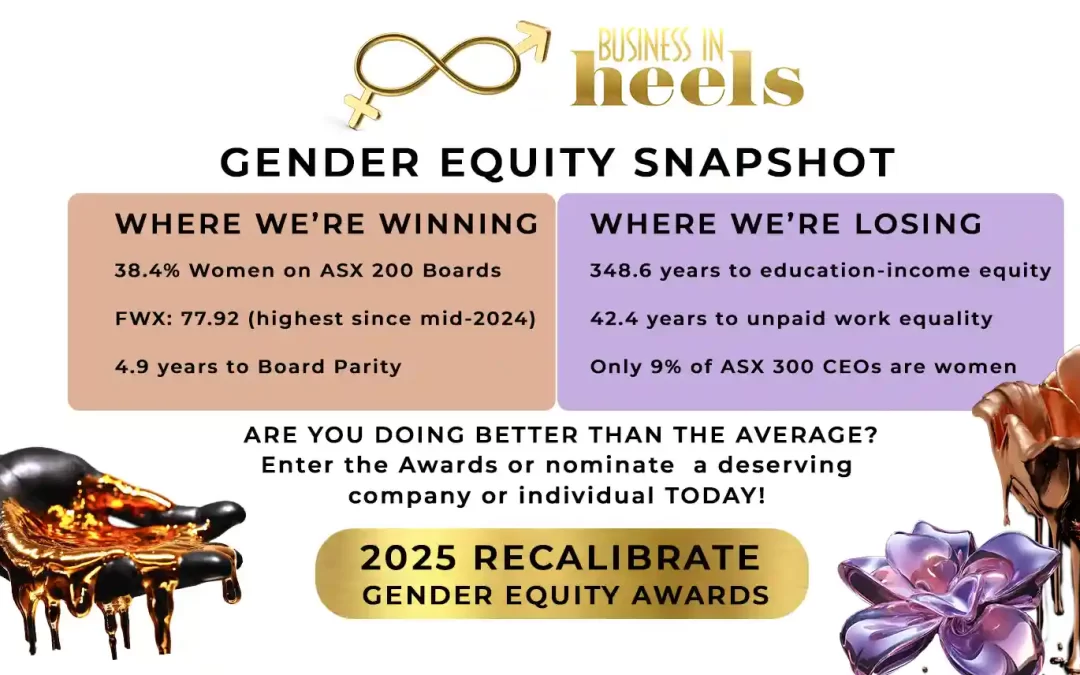
  • The Financy Women’s Index rose to 77.92 in March 2025, signalling the strongest progress since mid-2024.
  • 38.4% of ASX 200 board roles are now held by women — a record high.
  • Gender equality on boards is projected to be reached in just 4.9 years.
  • The gender pay gap narrowed to 11.9%, supported by wage boosts in key female-dominated sectors.
  • Men are contributing slightly more to unpaid care work, while female workforce participation is climbing steadily.

“These results show that Australia is on track to reach equality on ASX 200 boards by 2030 — a historic milestone for gender equality as one of the first widely campaigned and actioned areas closes in on parity.”
Bianca Hartge-Hazelman, Founder, Financy

⚠️ The Bad News: Deep Structural Inequities Remain

  • Equality in education-related earnings is 348.6 years away — driven by gendered career paths and pay gaps in chosen fields.
  • Time to equality in unpaid work is still 42.4 years, with women shouldering the bulk of care responsibilities.
  • Women’s gains in employment are still concentrated in low-paying, part-time roles, particularly in the care economy.
  • There are now fewer women CEOs in the ASX 300 than last year — down from 26 to 25.

“You don’t need to be a CFO to speak the language of money — but you do need to speak it to shape the decisions that matter… Financial fluency is often the unspoken language of power. And when access to that fluency isn’t equal — influence isn’t equal either.”
Natalie Previtera, CEO, NGS Super

To learn more The Financy Womens Index report.

Are You Outperforming the National Average on Gender Equity? Then Step Up.

We want to learn from you.

The Recalibrate – Gender Equity Awards shine a light on organisations that are leading the way. If your workplace has cracked the code — whether through policies, leadership pathways, or inclusive culture — now’s the time to share your playbook.

By entering the Awards, you’ll:

  • Gain national recognition
  • Help amplify effective practices
  • Inspire other organisations to act

Nominate or enter today and let’s fast-track progress, together: ENTER NOW

Let’s not just celebrate progress. Let’s share it, scale it, and sustain it.


Successful targets need more than box-ticking

Successful targets need more than box-ticking

 Using targets as a lever to create culture change needs more than box-ticking for compliance purposes. Without analysis, strategy and structural change that is underpinned by committed leadership, they may not only fail but backfire.

Current legislative environment

The Workplace Gender Equality Agency (WGEA) now requires larger employers to set one numeric and two action-based targets from a ‘menu’ of options across WGEA’s six gender equality indicators. The menu of action-based targets includes areas shown to drive improvements in gender equality outcomes. These are to be selected and reported to WGEA in 2026.

Why have targets been introduced?

Over the past decade, the national average gender pay gap (GPG) for total remuneration has decreased from 28.6% in 2015 to 21.8% today. But this is an average across all employers and industries so doesn’t tell the full story as there is significant variation between employers and industries.

The GPG, though not a perfect measure, serves as a useful proxy for gender equality. It is a relatable metric with a standardised format that makes it accessible to employers, employees and the media. It provides a year-on-year indicator of an organisation’s gender equality performance and highlights which organisations and industries have more work to do in this space.

Notably, due to the constraints of WGEA’s legislation, this measure doesn’t include other intersectional demographics such as race, age, disability, LGBTQIA+. Capturing and conducting your own intersectional analysis will give you more thorough and meaningful data.

But the GPG is complex, driven by factors such as industrial and occupational segregation, organisational culture, structural biases and social norms. Although many of these factors are historical and legitimately require time to shift, introducing targets is designed to accelerate the rate of change. They require a shift in thinking from being reactive to proactive.

For some employers, this is a welcome move, especially those who have already seen positive results from setting targets. For others, it may feel like an added burden and unnecessary.

But setting targets isn’t just about compliance. Targets aren’t about setting and forgetting, or boxticking. They can be used to your competitive advantage, leveraged as a tool to achieve equity and create inclusive cultures. This, over time, will also drive down your gender pay gap.


What are targets?

Targets are achievable, time-framed objectives which organisations can set on a regular basis to focus their efforts on achieving improved outcomes. The key here is ‘achievable’. Research shows that overly ambitious targets are less likely to be achieved and when targets aren’t achieved it can have a negative impact on organisations and reduce motivation to change.

Most organisations are familiar with setting targets for financial and operating performance. Gender and diversity targets operate in much the same way by setting objectives around key areas where change is needed or desired. They can help focus attention and demonstrate a commitment to deliver.


Does setting targets work?

Some believe targets unintentionally exclude others, leaving some to feel marginalised and resentful. Others think that targets (sometimes erroneously referred to as quotas) can result in what UK Business Psychologist Binna Kandola calls the ‘stigma of incompetence’. This is where those hired because of targets can be assumed less competent which obviously undermines their credibility.

Although setting targets is now a requirement for larger employers reporting to WGEA, having them in place is not enough.

If organisations focus only on meeting a target to be compliant without building internal capability or making the structural changes needed for sustainable progress and culture change, the underlying issues remain unaddressed, undermining longer-term success.

So how do you make sure targets don’t have unintended consequences by sending the wrong messages or driving behaviours that address symptoms not the cause of inequality?

When done correctly, targets are not about compromising on quality but about unlocking potential that may have been previously overlooked due to bias or systemic barriers.

Organisations must ensure their targets are meaningful, achievable, and embedded into a broader strategy for change. True progress comes from understanding the underlying issues, building internal capability, and setting a clear path for improvement.


How do I set targets for lasting change?

When thinking about how to achieve targets, it’s important organisations focus on structural change that embeds diversity, fairness, and inclusive behaviours into policies, systems and processes that ultimately benefit everyone. Below are some guiding principles.

1. To understand your current state and what are your REAL issues, conduct a DEEP data analysis that ideally includes other intersectional data. Guessing where to direct your efforts and resources isn’t a strategy. It’s crossing your fingers and hoping for the best….at best potentially a costly and wasteful approach.

It’s important when analysing your data to consider a longer period than just one year, e.g. look at data from three years. This will give a more stable picture of your operations and enable you to identify patterns.

Be wary about averages. Although meaningful in some ways, averages can mask poor performance. For example, you may have gender balance in management overall but when you dig deeper and analyse each manager category individually, you may find that the lowest level has 70% women and the highest level, 15% women. This would inform where actions are needed.

Further, if you have multiple work-sites it’s important to analyse data from each site individually. Although aggregating data may show gender balance across the group, you may have one site where management and other high-paying roles are very men-dominated, and another that is very women-dominated. This information is important in effectively tailoring your actions to where they are needed.

2. Using your data analysis findings, other information such as your business strategy, your organisation’s growth projections, turnover rates, any projected internal changes such restructures, and market conditions to inform what targets to set means they’ll be more realistic and achievable.

For example, if you’re expanding you can be more ambitious in what numeric targets to set, informed by the workforce planning that you’ll undertake. Alternatively, if you are in a period of consolidation or restructuring, you may want to focus more on setting retention or promotion targets.

3. Set your targets and organisation up for success by defining what structural changes are needed to drive real change. Introducing guard/guide rails in systems, policies and processes to create a workplace culture that is fair and inclusive will not only drive the change needed to achieve a target but will benefit all employees.

As part of this process, it’s important there’s genuine leadership commitment to gender equality and diversity particularly at the CEO and executive management level.

To mainstream gender equality and diversity as a business priority and not only as a side project, you’ll want to link your gender equality and diversity strategy to your values and include it as part of your business strategy.

4. Build capability and understanding – educate your workforce on systemic bias, inclusive leadership, the rationale behind diversity targets and the value of a diverse workforce. It’s important to communicate that a target isn’t tokenism, it’s not a quota, it’s a strategic advantage.

5. Communicate to your workforce that the changes to systems and processes are occurring to create a diverse and inclusive environment where all employees are valued for their unique perspectives and contributions. This is important in getting buy-in so all your workforce can see the benefits for everyone.

6. Embed accountability – link target outcomes to KPIs for leaders.

7. To build trust and momentum, measure and communicate progress transparently.


In conclusion, using targets as a lever to create lasting culture change requires more than box-ticking for compliance purposes. When supported by strategic leadership that’s committed to genuine action, targets that are well-designed and grounded in data can be powerful drivers of change.


Tranby Aboriginal Co-operative: Empowering First Nations Women Through Education

Tranby Aboriginal Co-operative: Empowering First Nations Women Through Education

For 68 years, Tranby Aboriginal Co-operative has been a beacon of empowerment for Aboriginal and Torres Strait Islander peoples, transforming lives through education. As Australia’s oldest independent Indigenous education provider, Tranby has played a pivotal role in fostering leadership, knowledge, and opportunity within First Nations communities.

A key pillar of Tranby’s impact is the Yanalangami: Strong Women, Strong Communities program—an initiative dedicated to equipping First Nations women with the skills and confidence to navigate both corporate and cultural spaces. With over 130 Changemaker graduates, Yanalangami is not just about personal growth; it’s about creating a ripple effect of leadership and transformation across communities.

One such leader is Katherine Stone, who joined Yanalangami in 2022. After completing the intensive six-week online program, she went on to become a Community Facilitator through the ‘Train the Trainer’ initiative. Today, as National Program Manager for Yanalangami, Katherine is at the forefront of the program’s expansion, ensuring that the next generation of First Nations women are empowered with knowledge, confidence, and a strong sense of purpose.

Tranby’s commitment to gender equity and community empowerment was recently recognized when it won the First Nations Business category of the Gender Equity Awards—a testament to its enduring impact in fostering leadership and opportunity for Indigenous women.

Through its education programs, cultural leadership initiatives, and unwavering dedication to First Nations empowerment, Tranby continues to pave the way for a stronger, more inclusive future.

It’s Time to March Forward: How You Can Drive Meaningful Change

It’s Time to March Forward: How You Can Drive Meaningful Change

By Lisa Sweeney

International Women’s Day is a powerful reminder that change starts with action. While conversations around gender equity are important, it’s time to move beyond discussion and take tangible steps toward a more inclusive world. The reality is stark: the gender pay gap, lack of women in leadership, and financial insecurity for women over 50 remain persistent challenges. However, you can make a difference—by influencing just one person.

1. Speak Up – Silence Gives Tacit Approval
Too often, people remain silent in the face of bias or discrimination. But saying nothing can be perceived as approval. Instead, challenge inappropriate remarks or behaviors by calmly stating, “That does not align with our values” or “We strive for inclusion and respect in this workplace.” Your voice matters.

2. Ensure Good Ideas Are Heard
How often have you seen someone cut off a colleague or take credit for their idea? Encourage active listening, reinforce good ideas by acknowledging their source, and ensure everyone in the room has a chance to contribute. A simple “That was a great idea from [name]” can go a long way.

3. Challenge Bias – Including Your Own
Bias, whether conscious or unconscious, influences decision-making. Take time to reflect on your own biases and address them. If you notice bias in hiring, promotions, or day-to-day interactions, call it out and advocate for fair treatment.

4. Advocate for Thoughtful Business Practices
Create a culture where no one feels less than, unheard, or unwelcome. That means ensuring everyone in your workplace is valued, their contributions are recognized, and their needs are met—including flexibility for caregiving, accessible workplaces, and inclusive policies.

5. Build Awareness of the Business Case for Diversity
Companies that reflect their communities make better decisions and serve their stakeholders more effectively. Diverse teams bring fresh perspectives and innovative solutions. The data is clear—equity isn’t just the right thing to do; it’s good for business.

6. Support Menstrual and Menopause Leave
Forward-thinking businesses are already seeing results from introducing menstrual and menopause leave. Not only do these policies support employees’ well-being, but they also reduce recruitment costs by making workplaces more attractive and inclusive.

7. Encourage Men to Be Allies
Men play a crucial role in achieving gender equity. Encourage them to take advantage of new parental leave privileges, advocate for women in leadership, and actively challenge bias. True allyship is about action, not just words.

8. Advocate for Equal Pay
Ensure pay transparency and fairness in your workplace. If you’re in a position of influence, push for salary audits and equitable compensation policies. If not, support initiatives that promote equal pay for equal work.

9. Push for Balanced Recruitment
If your candidate pool isn’t diverse, reconsider the criteria you’re using. Are you unintentionally creating barriers? Diverse hiring leads to stronger teams and a more inclusive culture.

10. Be a Mentor or Sponsor
One of the most impactful ways to create change is by supporting a woman in your workplace or community. Provide guidance, open doors, and offer opportunities for growth. Recognize that intersectionality—factors like race and disability—can double the barriers individuals face.

Take Action Today
Change doesn’t require grand gestures. Sometimes, all it takes is speaking up, mentoring someone, or challenging an outdated practice. This International Women’s Day, let’s move beyond the talk fest. Let’s take action.